

Health Economics in Morocco: Coverage and Sovereignty
A debate on health economics in Morocco, spanning universal coverage, sustainable financing, regional equity, public-private partnerships and pharmaceutical sovereignty.
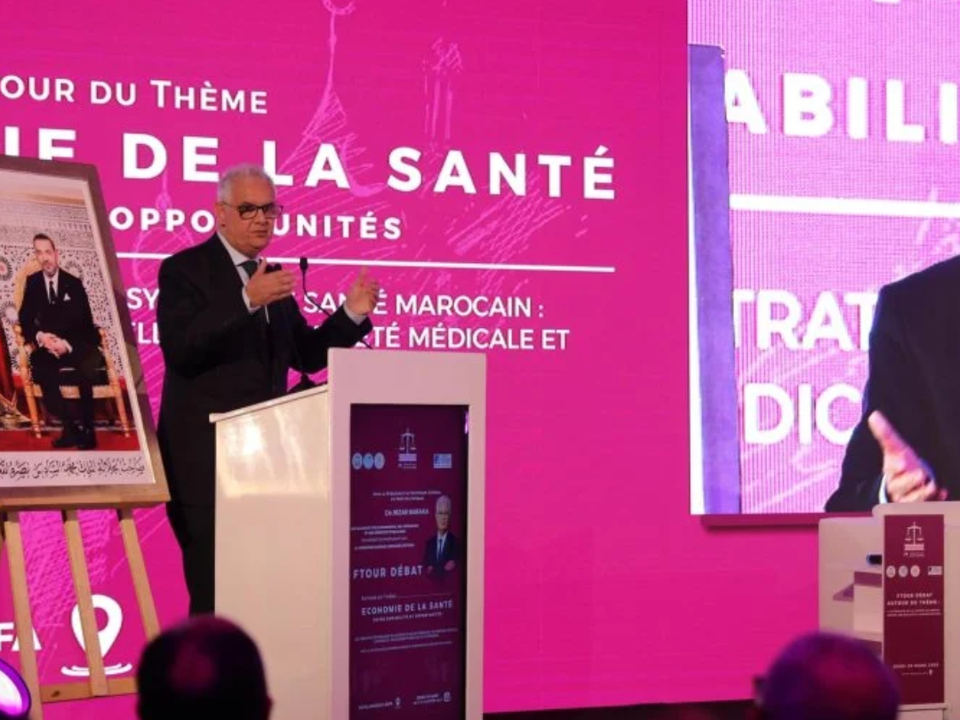
On March 20, 2025, the Alliance of Istiqlalian Economists (AEI), in partnership with the Alliance of Engineers, the Alliance of Doctors and the Konrad Adenauer Stiftung Foundation, organized a debate on health economics in Morocco, a timely issue as the country aims for universal health coverage (UHC) by 2025. The event, covered by LeMatin, explored crucial issues such as sustainable financing, improving the care offer through telemedicine, and governance to reconcile the public and private sectors, with a particular focus on the pharmaceutical industry to strengthen health sovereignty.
Context and Importance
The event took place at a key moment, as health coverage in Morocco has progressed. Morocco has tripled the number of AMO beneficiaries in just a few years. From 7.8 million insured people in 2020, the country now has 25 million people covered by the CNSS. The discussions reflected national priorities, particularly after Covid-19, when health sovereignty became a priority, with local production covering 65% of pharmaceutical needs.
Main Themes and Key Contributions
The main areas of the debate are summarized below:
- Abdellatif Maazouz: systemic approach to universal coverage, integrating financing, innovation and logistics. Key figure: health at 6% of Moroccan GDP, compared with 10% in developed countries.
- Nizar Baraka: equity through regional university hospitals, deconcentration, sovereignty through local production and prevention. Key figures: 45% of public doctors, 65% of private doctors, 70% of clinics and 55% of private beds concentrated in three regions; local production at 70% of needs; integration to be raised from 20% to 50%.
- Ryad Mezzour: a competitive pharmaceutical industry through exports and investment in chemistry to strengthen sovereignty. Key figures: local production at 75% of medicine boxes and 50% of turnover; 80% of reimbursed medicines imported; exports to be increased from 10% to 70% of turnover; 65,000 jobs.
- Hassan Boubrik: tariff balance without aligning the public sector with the private sector, and a reasonable increase in spending for sustainability. Key figures: around 200 unlisted medical acts; health expenditure at 5.3% of GDP in 2018, with a target of 6.5% to 7%.
- Khalid Lahlou: cost concentration linked to chronic diseases and the need for expanded public-private partnerships. Key figures: 2.9% of insured people consume 57% of CNSS expenditure; out-of-pocket costs exceed 35% for patients.
- Dr Mohamed Elmandjra: public-private synergy for a comprehensive care offer, without opposing the two sectors.
Abdellatif Maazouz: A Comprehensive Approach to Universal Coverage
Abdellatif Maazouz, president of the AEI, opened the debate by stressing the urgency of a systemic approach to universal health coverage, integrating the care offer, financing, innovation and logistics. He justified this focus with three reasons: the national commitment to this ambitious program, the need to ensure sustainability in the face of demographic growth, and the economic role of health, which represents 6% of Moroccan GDP compared with 10% in developed countries. For him, this comprehensive vision is crucial to meet growing needs while strengthening Morocco's position in Africa.
Nizar Baraka: Equity and Sovereignty as Pillars
Nizar Baraka, secretary general of the Istiqlal Party, emphasized equity and health sovereignty as the foundations of a robust system. For equity, he proposed university hospitals in every region to correct disparities, noting that 45% of public doctors and 65% of private doctors are concentrated in three regions (Casablanca-Settat, Rabat-Sale-Kenitra, Marrakech-Safi), where 70% of private clinics and 55% of private hospital beds are located. On sovereignty, he called for increasing pharmaceutical integration from 20% to 50% and producing active ingredients, with local production already covering 70% of needs. He also insisted on prevention, often neglected, as a lever for sustainable health.
Ryad Mezzour: A Pharmaceutical Industry Geared Toward Exports
Ryad Mezzour, Minister of Industry and Trade, argued for an internationally competitive pharmaceutical industry. Although Morocco produces 75% of medicine boxes locally, this represents only 50% of turnover, and 80% of reimbursed medicines are imported. He set an ambitious goal: increasing exports from 10% to 70% of turnover for an industry employing 65,000 people. To achieve this, he stressed the need to invest in chemistry and simplify regulations, in order to triple or quadruple the size of the sector while strengthening health sovereignty.
Hassan Boubrik: Tariff Balance for Sustainability
Hassan Boubrik, director general of the CNSS, addressed pricing and financial sustainability. He said he was open to revising the National Reference Tariff (TNR), but opposed aligning public-sector prices with private-sector prices, instead proposing a slight increase for the public sector to encourage its use. On medical acts, he corrected an estimate of 700 to 800 unlisted acts, bringing the figure down to around 200 after integration into bundled packages. He also suggested a reasonable increase in health expenditure, from 5.3% of GDP in 2018 to 6.5-7%, to maintain a balance between needs and resources.
Khalid Lahlou: Spending Concentration and Partnerships
Khalid Lahlou, president of the Alliance of Istiqlalian Doctors and director of ANAM, warned against cost concentration, revealing that 2.9% of AMO insured people consume 57% of total CNSS expenditure, often for chronic diseases linked to aging. He pointed to high out-of-pocket costs for patients, above 35%, and argued for including new reimbursable treatments. On public-private partnership, he criticized the limited 2015 framework and proposed three levels: financing, services and mixed management, while highlighting the challenges of making the public sector attractive to private investors.
Dr Mohamed Elmandjra: Public-Private Synergy
Dr Mohamed Elmandjra, CEO of the Oncology and Diagnostics of Morocco group, defended collaboration between the public and private sectors. Responding to Baraka, he insisted that the success of the private sector should not be seen as a failure of the public sector, advocating complementarity to improve the care offer. Although he did not provide specific figures, his intervention reinforced the idea of an integrated system in which each sector contributes to high-performing overall health, a key point for reducing access disparities.
Conclusion
This event revealed a clear ambition: to transform Morocco's health system into a lever for sustainable development. The figures - 6% of GDP for health, 45% of public doctors in three regions, and 2.9% of insured people consuming 57% of expenditure - underline the challenges of equity and sustainability.
These discussions offer paths forward: how can Morocco move beyond current constraints to make health a real driver of development? Health sovereignty, public-private synergy and prevention have been identified as key areas, but their implementation requires a coherent vision and ambitious strategic choices. The challenge remains to guarantee sustainable financing while ensuring equitable access to quality care. How can the country reconcile these imperatives to build a sustainable and inclusive health system?