

Health Reform in Morocco: The Legal Framework
An overview of Morocco’s health reform legal framework, from Framework Law 09.21 on social protection to Framework Law 06.22 on the national health system and its governance bills.
Through a series of framework laws and innovative measures, Morocco has embarked on a far-reaching transformation of its health system, with the aim of improving the quality of care, expanding social coverage and strengthening sector governance. Guided by the enlightened vision of His Majesty King Mohammed VI, this major reform seeks to establish a modern, effective and resilient health system capable of meeting current and future challenges.
This reform is based on two essential framework laws, namely Framework Law 09.21 on social protection and Framework Law 06.22 on the national health system.
Framework Law 09-21 on social protection:
Framework Law 09-21 was approved during the Council of Ministers held on February 11, 2021, to expand social coverage to all Moroccans. The law seeks to achieve four major objectives over time:
- Expansion of compulsory health insurance (AMO): The objective is to extend compulsory health insurance to all Moroccans by 2022, representing 22 million additional beneficiaries.
- Generalization of family allowances: This measure provides for the generalization of family allowances, benefiting 7 million school-age children by 2022.
- Expansion of the contribution base for pension schemes: The objective is to include 5 million people from the active population who have no pension coverage by 2025.
- Generalization of loss-of-employment compensation: This measure aims to extend loss-of-employment compensation to all people before they obtain stable employment.
Framework Law 06-22 on the national health system:
Framework Law 06-22 was published in the Official Bulletin on December 9, 2022, and repeals and replaces Law No. 09.34 on the health system and healthcare provision. The law falls within the framework of generalizing compulsory health insurance (AMO) and introduces several new measures, including:
- New remuneration system: The framework law introduces a new remuneration system for health professionals, based on a fixed component and a variable component. This approach aims to better recognize and value the skills and performance of health professionals.
- New contract-based recruitment system: The framework law provides for the introduction of a contract-based recruitment system for health professionals. This will allow greater flexibility in human-resources management and make it easier to adapt to the needs of the health system.
- Opening the private sector to health professionals: The framework law creates a regulatory framework allowing health professionals to work in both the public and private sectors. This measure will promote mobility among health professionals and contribute to a better distribution of resources across the health system.
- Creation of the High Authority for Health: The framework law establishes the High Authority for Health, tasked with the technical supervision of health insurance and the promotion of care quality. This authority will play an essential role in improving medical care and ensuring patient safety.
Adopted draft laws:
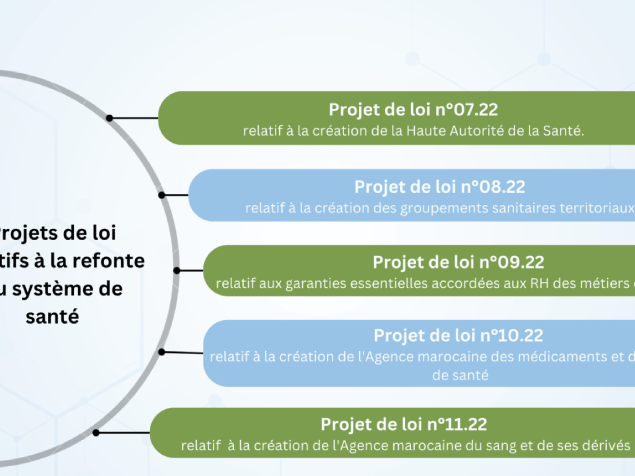
As part of the implementation of the High Royal Directives calling for health-system reform and the implementation of the pillars of this reform, draft laws 07-22, 08-22, 09-22, 10-22 and 11-22 fall within the execution of the national health-system reform priorities, particularly the governance pillar, in accordance with Article 32 of Framework Law No. 06.22 on the national health system.
- Draft Law No. 07.22 on the creation of the High Authority for Health. Its objective is to establish the High Authority for Health as a public-law legal entity responsible for ensuring continuity in state action in the field of health.
The High Authority for Health will have the main missions of technically supervising basic compulsory health insurance (AMO), evaluating the quality of services provided by public and private health facilities, and issuing opinions on public health policies. - Draft Law 08.22 on the creation of territorial health groups. It aims to address the constraints and obstacles affecting healthcare provision at the territorial level and to upgrade governance of the national health system. It proposes the creation of territorial health groups in each region, bringing together health facilities and defining their missions across six key areas: healthcare provision, public health, training, research and innovation, as well as administration. This draft law also establishes the administrative and management bodies of the health groups.
- Draft Law 09.22 on the essential guarantees granted to human resources in the health professions. It aims to strengthen legal-protection guarantees for human resources working in territorial health groups. It provides for mandatory continuing training programs throughout health professionals’ careers, as well as a motivating and effective remuneration system.
- Draft Law 10-22 on the creation of the Moroccan Agency for Medicines and Health Products. It aims to strengthen governance of the medicines and health-products sector by creating the Moroccan Agency for Medicines and Health Products. This agency will be responsible for implementing the state’s strategic policy orientations to ensure the availability, safety and quality of medicines and health products. The draft law defines the Agency’s administrative and management bodies, as well as its administrative and financial organization.
- Draft Law 11-22 concerns the creation of the Moroccan Agency for Blood and Blood Derivatives, which will replace the National Center for Blood Transfusion and Hematology (CNTSH) and the regional blood-transfusion centers. The Agency will be responsible for developing a blood stock that meets national needs and for ensuring the availability, safety and quality of blood-derived products. The legislative text establishes the Agency’s administrative and management bodies, as well as its administrative and financial organization.