
Health Works Leaders Coalition
Analysis of the Health Works Leaders Coalition and what it means for Morocco, from health investment and universal coverage to job creation, infrastructure, financing and health-finance governance.
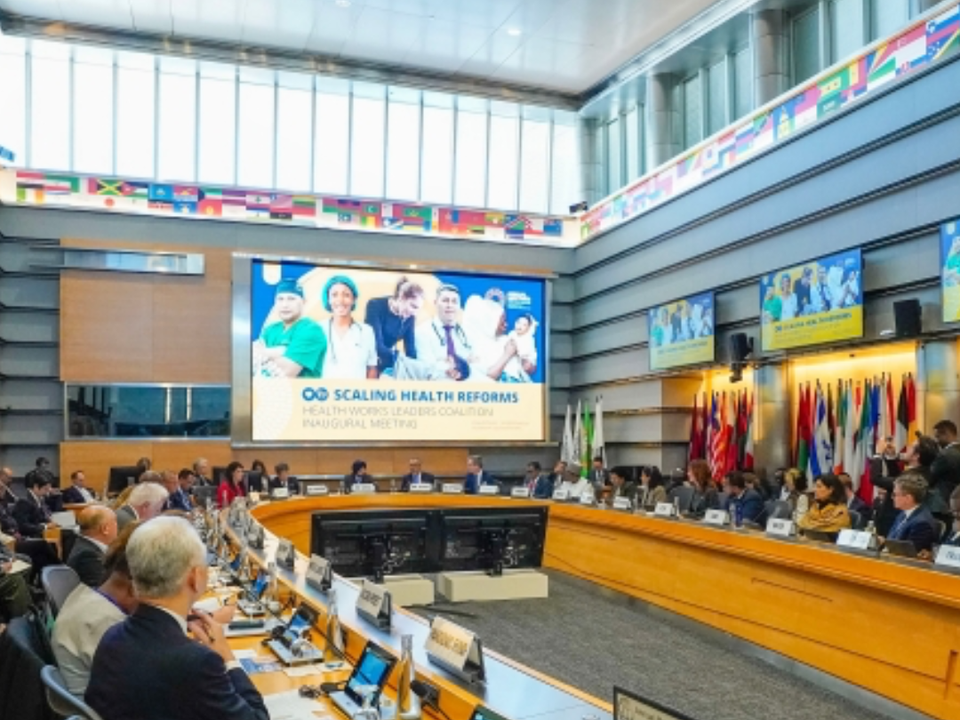
Health systems worldwide are under growing pressure: rising needs, scarce resources and higher expectations for quality and equity. This imbalance reveals structural underinvestment in health, which is often seen as a cost rather than a genuine economic driver. It is from this perspective that the Health Works Leaders Coalition was launched on October 17, 2025, a joint initiative by the World Health Organization (WHO), the World Bank and the Government of Japan to make health a catalyst for growth, productivity and jobs.
Morocco, among the first 21 countries to join the coalition, has committed to developing a national health pact to strengthen universal coverage and attract more investment into the sector. What does this coalition mean for Morocco, and what can be drawn from it in practical terms?
What Is It?
The launch of the Health Works Leaders Coalition marks the birth of an unprecedented international alliance bringing together ministers, financial institutions, development actors, civil-society organizations and the private sector around a shared goal: making investment in health systems a driver of economic growth and sustainable job creation.
Its members include Egypt, Ethiopia, Gavi Alliance, Indonesia, Nigeria, the Philippines, Seed Global Health, Sierra Leone, Saint Lucia, the Global Fund to Fight AIDS, Tuberculosis and Malaria, the Susan Thompson Buffett Foundation, the United Kingdom, WACI Health and the Wellcome Trust.
Unlike many initiatives focused exclusively on public health, this coalition takes a resolutely cross-sector approach. It brings together health and finance ministers, as well as partners from economic development, vocational training, labor and innovation. This positioning reflects a shared conviction: health policies can no longer be designed in isolation, but must be part of an integrated vision of development.
The founders (WHO, the World Bank and Japan) each play a key role:
- WHO provides political coordination and knowledge sharing through its Universal Health Coverage (UHC) Knowledge Hub.
- The World Bank mobilizes its financial expertise and investor network to support national strategies.
- Japan, a long-standing advocate of UHC, acts here as a diplomatic and financial leader, reflecting the continuity of its post-COVID commitment to strengthening global health systems. The composition of the first group of 8 countries (Cambodia, Egypt, Ethiopia, Ghana, Indonesia, Kenya, Nigeria and the Philippines) participating in the inaugural program of the UHC Knowledge Hub in Tokyo clearly illustrates Japan’s commitment.
Around this central core, the coalition invites states, regional organizations, companies, foundations and NGOs to join the effort through "national health and prosperity pacts" adapted to each country’s priorities and context.
What Are the Coalition’s Objectives?
Clear Objectives: Investing in Health to Stimulate the Economy
The stated ambition is twofold:
- Increase domestic and international investment in health systems, treating them as productive investment rather than expenditure.
- Create quality jobs in the health sector, especially for women and young people, while strengthening economic and social resilience.
Among WHO’s objectives, health-related jobs should reach 10 million by 2030 in low- and middle-income countries. But persistent inequalities in financing, training and governance are slowing this potential. The coalition therefore aims to create an enabling environment where every dollar invested in health generates a measurable social and economic return.
What Distinguishes This Coalition from Earlier Ones: Three Key Innovations
Shared governance between health and finance:
Unlike many earlier initiatives dominated by health ministries or donors, the Health Works Leaders Coalition is based on political and budgetary co-management. By bringing together the health and finance portfolios, it seeks to break down the historical separation between these two spheres. The idea is to integrate health into macroeconomic planning, on the same level as infrastructure or education. "Our goal is ambitious: to help countries provide quality, affordable health services to 1.5 billion people by 2030. No single institution, no government and no philanthropist can do it alone," said Ajay Banga, President of the World Bank Group.
A clear focus on employment and productivity:
Where other programs were limited to financing care or equipment, this coalition emphasizes employment as the central link between health and the economy. The health sector already represents 10% of global GDP and employs more than 234 million people (2019 figure). By building on this reality, the coalition seeks to make health a driver of inclusive growth rather than a public spending item.
The issue is therefore not to redistribute funds, but to change the logic of health investment by encouraging countries to adopt coherent, measurable national strategies focused on economic returns.
A genuinely cross-sectoral and inclusive approach:
Finally, the coalition stands out through its multi-stakeholder architecture, where governments, international institutions, the private sector and civil society are invited to co-build strategies. The coalition acts as a space for political coordination, knowledge sharing and investment incentives, rather than as a financial window. It does not only aim to increase budgets, but to transform governance, investment and training models. This means involving ministries of labor, education, the digital economy and even the environment, in order to address health determinants comprehensively.
What Benefits for Morocco?
Morocco’s membership in the Health Works Leaders Coalition would represent far more than a diplomatic gesture. It fits directly into the logical continuation of ongoing structural reforms, especially the generalization of Compulsory Health Insurance (AMO), the overhaul of care infrastructure and the growing role of the health sector in the country’s economic development strategy.
A lever for financing and international visibility:
While the 2026 Finance Bill provides for a record budget of 140 billion dirhams for education and health, Morocco is showing a clear commitment to investing in human capital. In this context, joining the coalition would make it possible to mobilize new international partners, whether public donors, impact investment funds or health-sector companies, by relying on a governance framework validated by WHO and the World Bank.
The issue is twofold:
- Attract international co-financing to support universal health coverage (UHC) reform and hospital modernization.
- Benefit from technical expertise and knowledge transfer offered by the coalition through its Knowledge Hub, particularly on sustainable financing, hospital governance and service digitalization.
This would strengthen Morocco’s credibility on the international stage, positioning it as an African pilot country in the connection between health policy and economic development.
Potential for job creation in health and related professions:
The coalition explicitly highlights the creation of quality jobs in health. For Morocco, this objective resonates with an urgent need.
By joining the coalition, Morocco could:
- Accelerate the training and integration of young health professionals, especially in underserved regions.
- Stimulate related sectors (medical technologies, biotechnology, hospital maintenance, logistics and e-health), thereby creating high-value indirect jobs.
- Strengthen health entrepreneurship by encouraging local start-ups to develop digital or logistics solutions that support UHC.
In other words, investment in health would become a lever for employment and innovation, not only a social-protection tool.
An opportunity to consolidate public infrastructure:
The coalition emphasizes the need to invest in national health systems as a foundation for prosperity. For Morocco, where territorial inequalities in access to care persist, this international momentum could:
- Accelerate the construction and rehabilitation of public hospitals, especially in rural or isolated regions.
- Strengthen the resilience of existing infrastructure by integrating energy-sustainability and digital-management standards.
- Facilitate the use of co-financing mechanisms (public-private, green funds and bilateral cooperation) for integrated hospital projects.
In short, the coalition could help Morocco move from a catch-up logic to a logic of sustainable health-system structuring.
Better connect health and economic policy:
Since 2021, Morocco has committed to a new development model that makes human capital a pillar of competitiveness. From this perspective, joining the coalition would make it possible to institutionalize dialogue between the Ministry of Health and the Ministry of Finance, which the coalition promotes globally.
This connection would offer several advantages:
- Integrate health into multi-year budget planning, to guarantee stable financing for UHC.
- Assess the economic returns of health policies in terms of productivity, poverty reduction and employment.
- Optimize the allocation of resources between prevention, primary care and hospitals, in order to avoid the spiral of inefficient curative spending.
This would place Morocco among the countries able to think of health not as a cost, but as a strategic economic investment.